
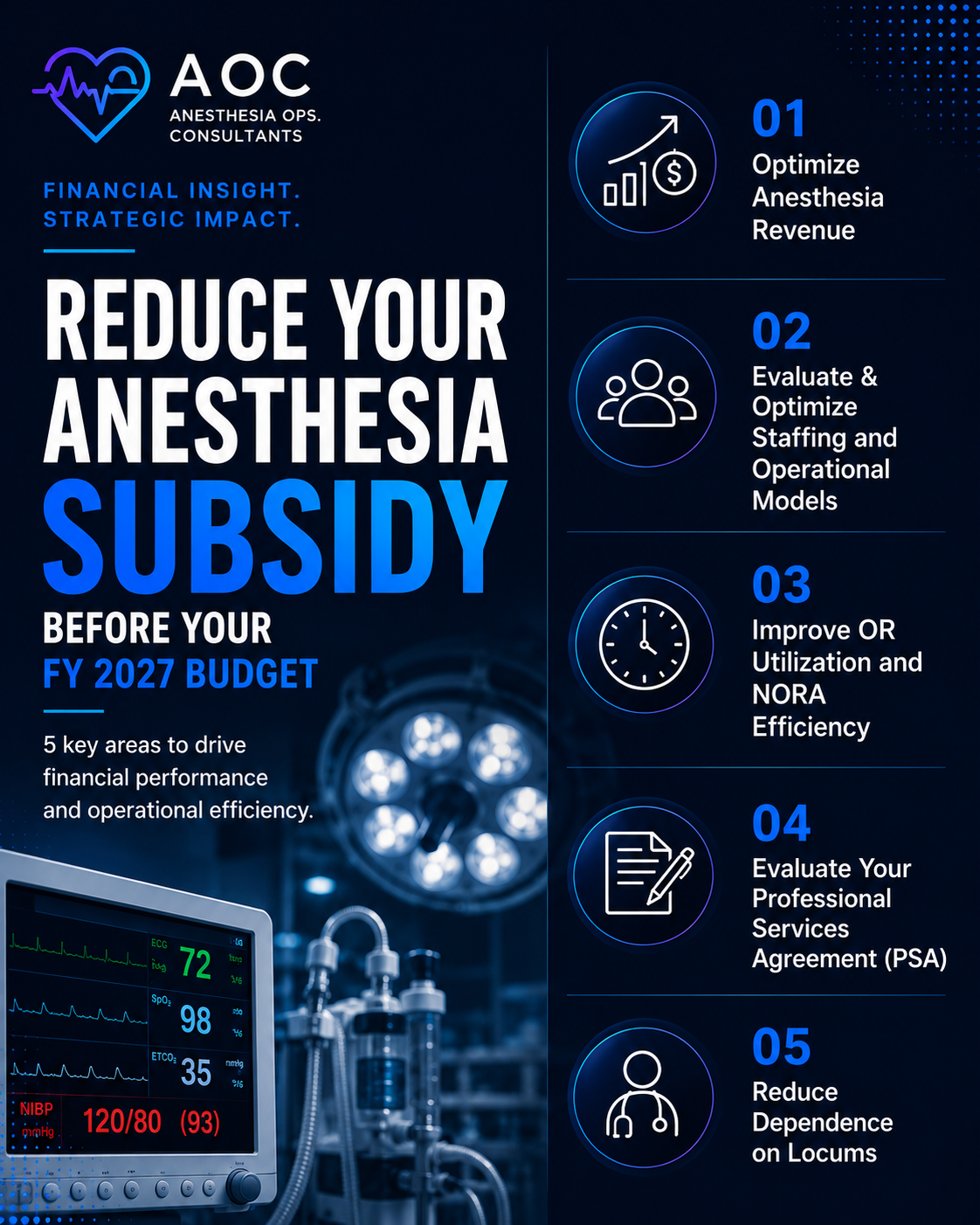

If your anesthesia service line has become one of the fastest-growing expenses in your hospital budget, you’re not alone. Across the country, hospitals are experiencing record anesthesia subsidy requests driven by workforce shortages, higher compensation, reimbursement pressure, and operational inefficiencies. The question isn’t whether your organization will need an anesthesia subsidy—it’s whether you’re paying more than you should.
As healthcare organizations prepare their 2027 budgets, now is the ideal time to perform a comprehensive anesthesia service line assessment to audit, verify and budget accurately. The largest opportunities to reduce subsidies are often found in five key areas.
1. Optimize Anesthesia Revenue: Enhance RCM performance and Commercial Contracting
Strong anesthesia revenue cycle management (RCM) can dramatically and directly improve financial performance without changes to surgical volume or staffing. Benchmarking commercial reimbursement, improving coding accuracy, optimizing payer contracts, reducing denials, and strengthening collections can generate significant incremental revenue.
An additional, often overlooked, revenue opportunity organizations should explore is the Independent Dispute Resolution (IDR) process under the No Surprises Act. Recent reporting has highlighted the billions of dollars recovered through federal IDR, demonstrating that many providers continue to realize substantial reimbursement improvements when arbitration is appropriately utilized.
2. Evaluate and Optimize Staffing and Operational Models
Many anesthesia service providers continue to staff based on historical “coverage” models rather than actual demand. Reviewing physician-to-CRNA ratios, expanding independent CRNA practice where clinically appropriate and permitted by state law, and aligning staffing with actual procedural volume can substantially reduce labor expense while maintaining quality and patient safety.
Reducing excess daily “coverage” through efficient models using actual volume benchmarked to productivity and utilization has immediate impact on cost of service, locum premium labor costs, vacancies and staffing “shortages”.3. Improve Operating Room Utilization and NORA Efficiency
Operating room utilization remains one of the most important drivers of anesthesia efficiency and productivity. Reviewing OR KPI’s (first-case start times, turnover performance, block utilization, and daily staffing assignments) frequently uncovers opportunities to eliminate excess anesthesia coverage.
The same evaluation should extend to Non-Operating Room Anesthesia (NORA) locations—including Endo/GI, Cath and EP Lab, MRI, OB/GYN and, Interventional Radiology. Visible, coordinated scheduling and shared flex staffing often improve productivity while maintaining service availability. Further opportunities often exist around implementation of best practice non-anesthesia sedation services.
4. Evaluate Your Professional Services Agreement (PSA)
Hospitals should periodically review whether their current Professional Services Agreement (PSA) still aligns with organizational goals for today’s market.
Hospitals can maintain greater control of anesthesia finances and business through owned or co-owned JV MSO arrangements whereby the hospital assumes control of the “business” side- billing entity, payer contracts, and revenue cycle- while contracting with an anesthesia group for clinical staffing, service, and medical leadership. Depending on the market, these structures may improve transparency, strengthen reimbursement oversight, and provide greater long-term financial flexibility.
5. Reduce Dependence on Locum Tenens
Locum and other premium labor anesthesiologists and CRNAs have become one of the largest contributors to escalating anesthesia costs. Locum rates can be 50-150% higher than standard labor costs.
Organizations should focus on long-term retention strategies, competitive compensation benchmarking, improved scheduling flexibility, leadership development, and recruiting initiatives that create permanent staffing solutions. Reducing locum utilization not only lowers cost but also greatly improves culture, workplace satisfaction, surgeon satisfaction, retention and physician engagement.
Preparing for FY 2027 Starts Today
The anesthesia cost center and subsidy requirement is increasingly impacting hospital budgets and the bottom line Minimizing this impact and accurate budgeting are crucial.
In the current environment nearly, every organization will benefit from, improvements in reimbursement, staffing optimization, operating room efficiency, NORA utilization, PSA structure, and provider retention; significantly reducing financial support while strengthening clinical operations.
At Anesthesia Operations Consultants, we exclusively specialize in helping hospitals, health systems, and anesthesia groups optimize financial performance and operational efficiency. Whether your organization is validating an anesthesia subsidy, renegotiating a PSA, improving commercial reimbursement, or developing a long-term staffing or alignment strategy, our team provides data-driven recommendations backed by decades of anesthesia leadership experience.
Learn more about our services and explore additional anesthesia industry insights at https://anesthesiaoperationsconsultants.com.