

Historically, CMS has reimbursed mid-level providers at 85% of the physician fee schedule, with one notable exception: anesthesia mid-level providers, including CRNAs, AAs, and Anesthesia NPs, have been reimbursed at 100%. This has held true whether the service was medically directed or billed under the QZ billing modifier (non-medically directed).
Commercial payers are now beginning to diverge from this CMS precedent by adopting an 85% rate for CRNA services. This is the inverse of the Medicare relationship where CRNAs are the only nursing specialty Medicare Part B authorizes to receive direct reimbursement at 100% of the physician fee schedule when non-medically directed (QZ). Commercial payers moving to 85% are diverging from CMS parity—not following it. For clarity, commercial payers have generally not changed reimbursement for commercially administered claims processed by such payers.
This trend is relevant to hospitals, ambulatory surgery centers (ASCs), and anesthesia service provider groups because of its potential impact on anesthesia reimbursement and subsidy requirements. Commercial payers are continuing to transfer financial burden to facilities and service providers.
Commercial Payers Applying an 85% Rate for QZ Services
Confirmed Policy Changes for Non-Governmental Insurance Products
Cigna
- First major national payer to adopt this policy on a wide-scale basis, effective 2023.
- 15% cut on QZ claims, framed as aligning CRNA reimbursement with other advanced practice provider (APP) methodology (85% versus 100% for physicians).
- Believed to be the first instance of a major national health insurer taking this position.
Anthem / Elevance (BCBS)
- Effective November 1, 2024.
- Reduces QZ services rendered by a CRNA to 85% of the physician fee schedule.
- Rollout has varied by state; Ventra Health has noted the policy applies only in select states.
UnitedHealthcare
- Effective for anesthesia services rendered on or after October 1, 2025.
- Moves CRNA reimbursement toward an 85% benchmark—a 15% reduction for personally performed anesthesia services billed with modifier QZ.
UnitedHealthcare — Official Bulletin Detail
| Item | Detail |
| Effective date | October 1, 2025 (November 1, 2025 for CO, KY, OH, RI) |
| Reduction | 15% reduction on CRNA personally performed services billed with modifier QZ |
| Stated rationale | Explicitly framed as aligning CRNA reimbursement methodology “with other advanced practice providers” |
| Exempt states | Arkansas, California, Colorado, Hawaii, Massachusetts, New Hampshire, Wyoming |
| Additional change | Physical status modifiers (P3–P5) and qualifying circumstance codes (99100, 99116, 99135, 99140) are dropped from the calculation entirely—a separate reduction beyond the 85% rate itself |
Source: UHC Commercial Reimbursement Policy Update Bulletin, July 2025
Could CMS Also Move CRNA Reimbursement to 85%?
Given CMS’s historical willingness to modify anesthesia reimbursement, it is reasonable to ask whether Medicare could eventually follow the commercial payer trend.
Legal Basis Today
42 CFR §414.60(a)(2) establishes that the conversion factor for an anesthesia service furnished by a CRNA who is not medically directed by a physician may not exceed the conversion factor for a service personally performed by a physician.
This is a ceiling, not a specific rate mandated by statute. CMS has simply chosen, through regulation, to set the CRNA conversion factor equal to the physician conversion factor—100%.
This regulation traces back to the original Physician Fee Schedule rulemaking (56 FR 59624, November 25, 1991), as amended through 1995, issued under CMS’s general statutory rate-setting authority (Section 1848 of the Social Security Act)—the same authority CMS uses for its annual PFS rulemaking.
Why CMS Could Make This Change Without New Legislation
Unlike the NP/PA 85% rate, which Congress set directly in statute through the Balanced Budget Act of 1997, codified at Section 1833(a)(1)(O), the CRNA 100% figure is a CMS regulatory choice, not a statutory mandate.
This means CMS could propose lowering the CRNA conversion factor to 85% through the same annual notice-and-comment rulemaking process already used to update 42 CFR Part 414 each year—the same vehicle producing the CY2027 PFS proposed rule.
This would require:
- A proposed rule amending 42 CFR §414.60(a)(2), with a stated rationale such as cost savings, alignment with other APP payment methodology, or MedPAC-style analysis.
- A 60-day public comment period — standard for any PFS rulemaking.
- A final rule responding to comments, with an effective date, typically the following January 1.
- A budget neutrality adjustment — Section 1848(c)(2)(B) requires PFS changes to be budget-neutral, meaning savings from a CRNA cut would redistribute elsewhere in the fee schedule. This redistribution requirement invites intense specialty-society lobbying on both sides of the issue.
What the 85% Rule Means for Anesthesia Financial Performance
The key questions for hospitals, ASCs, and anesthesia service provider groups are straightforward: What happens if commercial payers continue moving to 85%? What happens if CMS ultimately regulates a similar change to bring CRNA reimbursement in line with other mid-level providers?
The answer to both is lower anesthesia revenue. Without action, this will translate into higher anesthesia subsidy requirements on top of other common anesthesia subsidy drivers, including compensation, inefficiency, and low rates.
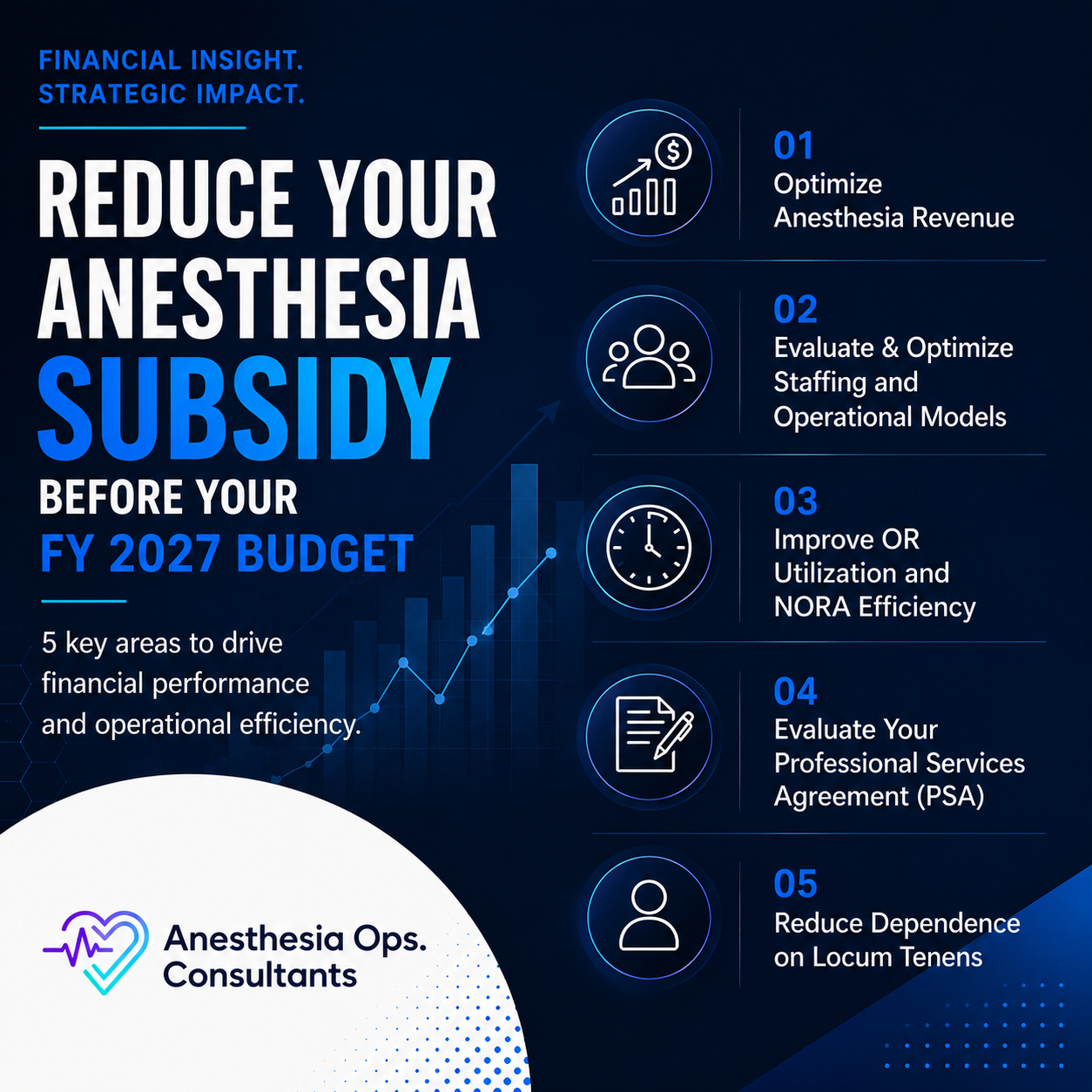
However, action can partially or completely offset reduced revenue through more efficient operating models built with the help of industry experts. The additional challenge of the 85% rule reinforces the need for hospitals, ASCs, and service groups to operationally and financially optimize anesthesia service line performance to ensure the lowest cost of service and subsidy.
Comprehensive expert analysis and assessment of your service line—including alternative staffing and operational models to quantify and minimize the impact of lower CRNA reimbursement—is one example of the value clients can access through an AOC engagement.
Let us help you navigate the increasingly complex and challenging anesthesia reimbursement landscape.
Turn Reimbursement Pressure Into Opportunity
A comprehensive assessment of your anesthesia service line, including alternative staffing and operational models, can help quantify the impact of lower CRNA reimbursement and uncover opportunities to offset lost revenue. Anesthesia Operations Consultants bring the anesthesia specific expertise, data driven analysis, and strategic guidance needed to strengthen financial performance and build a more sustainable service line.
By evaluating operations, staffing, financial performance, and anesthesia reimbursement, we help hospitals, ASCs, and anesthesia groups identify opportunities to strengthen performance, control costs, and reduce the impact of changing payer policies. With the anesthesia landscape becoming increasingly complex, the right data, expertise, and strategy can help organizations protect financial performance while maintaining high-quality care.