Anesthesia Subsidy and Staffing Insights
Subsidies, fair market value, CRNA staffing, revenue cycle, and RFPs — written for the people who have to price the coverage.


ASC anesthesia company model vs contracting a group: what surgery center owners should weigh
The company model lets ASC owners keep part of the anesthesia fee. It also moves collections risk to them and raises the anti-kickback questions the OIG set out in 2012. Here is how it compares with contracting a group.
Read Full Article
ASC anesthesia services: an independent review of coverage and cost for surgery centers
Stipend request, new group or your own anesthesia company? AOC compares the options for your surgery center from your own data, shows the math and charges a fixed fee.
Read Full Article
Anesthesia Program Budget Development Framework: Surgical & OB Services
A seven-part framework for building an anesthesia program budget for surgical and OB services: historical baseline, volume and case mix, billing units, payer mix and expected collections, staffing and labor cost, overhead, and the summary financial model.
Read Full Article
Building and Maintaining a Strong Hospital-Anesthesia Service Relationship
Weak relationships sit behind many failing anesthesia service lines. What hospitals and anesthesia groups each reasonably need, how trust gets built, and a checklist across subsidy, leadership, clinical, operational and strategic responsibilities.
Read Full Article
Why Your Hospital’s Anesthesia Subsidy Keeps Growing and How to Reduce It Before Your FY 2027 Budget
If your anesthesia service line has become one of the fastest-growing expenses in your hospital budget, you’re not alone. Across the country, hospitals are experiencing record anesthesia subsidy requests driven by workforce shortages, higher compensation, reimbursement pressure, and operational inefficiencies. The question isn’t whether your organization will need an anesthesia subsidy, it’s whether you’re paying more than you should.
Read Full Article
Understanding the 85% Rule and Its Impact on Anesthesia Reimbursement
Medicare pays CRNAs 100% of the physician fee schedule. Commercial payers are moving QZ claims to 85%, and the gap lands on hospital and ASC budgets.
Read Full Article
Understanding Anesthesia Billing Compliance in Today’s Healthcare Environment
The questions every anesthesia practice should be asking are simple: Is your anesthesia billing compliant? Are you capturing every reimbursable opportunity? The answers, however, require a working knowledge of a modifier system that was designed for a healthcare landscape that no longer exists, and the financial stakes of getting anesthesia billing compliance wrong can be significant. Understanding how billing rules, medical direction, and the QZ modifier function in today’s environment is essential for protecting both anesthesia reimbursement and compliance.
Read Full Article
How to Build High-Performing Anesthesia Services in Today’s Healthcare Environment
Hospitals and health systems rely on high-performing anesthesia services to ensure safe patient care, maintain surgical volume, and drive financial stability. Yet many organizations struggle with inefficiencies, rising subsidy costs, or misaligned incentives within their anesthesia departments. To build and maintain a high-performing anesthesia service line, healthcare leaders must evaluate four critical areas: operational efficiency, financial performance, clinical quality, and leadership alignment.
Read Full Article
Anesthesia Payer Negotiations: A Strategic Imperative for CFOs and COOs
Hospitals and healthcare systems nationwide are facing unprecedented pressure from rising anesthesia subsidies. Driven by a shortage of anesthesia providers, inflation, decreasing reimbursements, and shifting care models, these stipends are threatening hospital margins. However, managing these costs effectively is possible without compromising clinical quality. A structured, data-driven approach to anesthesia consulting and strategic planning can help hospital leaders align resources, optimize revenue, and regain control over their anesthesia operations.
Read Full Article
Should Hospital Leaders Consider Allowing a 1099 CRNA Staffing Model?
Hospitals across the country are facing unprecedented pressure in anesthesia staffing. Demand for Certified Registered Nurse Anesthetists (CRNAs) continues to rise, compensation expectations are increasing rapidly, and traditional anesthesia employment models are struggling to keep pace. As a result, many hospitals are being asked—either directly by their anesthesia groups or indirectly through recruitment challenges—whether a 1099 independent contractor model should be part of their anesthesia staffing strategy.
Read Full Article
Managing Rising Anesthesia Subsidy Pressures in 2026
Anesthesia services are undergoing significant change, creating new challenges for hospitals as they work to manage growing subsidy pressures. Our 2025 findings project a 16% increase in anesthesia subsidies, but 2026 is expected to show much higher variability. Around 20-25% of subsidies may see reductions due to factors such as independent dispute resolution (IDR) engagement, facility employment, or MSO/PSA/physician integration models. Understanding these options are critical for hospitals seeking to maintain financial stability while delivering high-quality care.
Read Full Article
Minimizing Audit Risks in Anesthesia Coding
Anesthesia coding plays a critical role in ensuring both compliance and financial stability for providers. With frequent regulatory updates and complex documentation requirements, even small errors can lead to costly audits, denied claims, or financial penalties. For anesthesia groups, staying proactive about audit risks is essential to protecting revenue and supporting high-quality patient care.
Read Full Article
Optimizing Anesthesia Staffing for Financial & Clinical Impact
Staffing anesthesia services has become a strategic priority as hospitals navigate persistent provider shortages, rising costs, and the need for seamless clinical operations. In recent years, many organizations have moved towards employing their own anesthesia teams to gain more control—but that approach is now under review. The stakes are higher than ever before, and leaders are reassessing whether direct employment, anesthesia outsourcing, or a hybrid anesthesia staffing model offers the most sustainable path forward. Choosing the right approach starts with understanding the trade-offs, benefits, and the long-term impact of each model on clinical performance and financial stability.
Read Full Article
A Smarter Solution for Resolving Anesthesia Subsidy Disputes
As anesthesia subsidies continue to surge—projected to increase by 16% in 2025 alone—many hospitals and anesthesia groups are facing tough questions around how to fairly assess and negotiate support levels. With costs rising and reimbursement tightening, the need for fair market value (FMV) evaluations has never been greater. Yet the traditional approach—with each side hiring separate consultants—often results in distrust, delays, and inefficient outcomes. Anesthesia Operations Consultants is proud to offer a more effective path to navigate anesthesia subsidy negotiations: the Bilateral Anesthesia Arbitration Evaluation, a shared, neutral approach to establishing transparent and equitable anesthesia support.
Read Full Article
Redefining Anesthesia Leadership: Shared Models, Sustainable Staffing, and the Evolving Role of CRNAs
An expert panel on CRNAs in strategic leadership, internal vs. outsourced anesthesia models, hospital financial pressure, and why culture drives recruitment.
Read Full Article
Independent Dispute Resolution (IDR) and Fair Reimbursement
IDR is the No Surprises Act’s arbitration process for out-of-network payment disputes. How it works for anesthesia, the latest win rates, the $15 fee, the 2026 batching rules, the deadlines and getting paid.
Read Full Article
Anesthesia Billing: Avoiding Risks and Maximizing Efficiency
Anesthesia billing compliance is crucial to healthcare administration, ensuring accurate and ethical billing practices for anesthesia services. As health systems evolve, the complexities surrounding anesthesia billing and reimbursement processes continue to grow, making compliance more essential than ever. The urgency of this issue is underscored by the rising trend of private practice anesthesiologists transitioning to health system employment. Recent data indicates that over the past 20 months, more than 100 anesthesiologists per month have made this shift. Non-compliance is not just a financial risk—it can result in millions of dollars in fines and even criminal penalties. Understanding the role of anesthesia billing compliance, challenges faced by hospitals employing anesthesia providers, and solutions to maintain adherence can help healthcare organizations mitigate risks and optimize operational efficiency.
Read Full Article
Annual Fair Market Evaluations in Hospital Anesthesia Groups
Amid rising workforce shortages and increasing financial pressures, ensuring fair and competitive compensation for anesthesia providers is critical. The demand for skilled anesthesiologists and Certified Registered Nurse Anesthetists (CRNAs) remains high, influenced by increasing patient needs and evolving medical practices. Annual fair market evaluations can play a key role in helping hospitals stay competitive, manage compensation effectively, and retain skilled anesthesia providers.
Read Full Article
Navigating the 2025 Anesthesia Subsidy Surge
A projected 16% increase in anesthesia subsidies for hospitals in 2025 is making waves in the healthcare industry. This significant rise stems from mounting pressures, including a 4.4% increase in anesthesia department expenses, driven by higher physician and CRNA salaries, and compounded by declining reimbursement rates. Hospitals must navigate the 2025 anesthesia subsidy surge strategically to ensure the sustainability of their anesthesia services.
Read Full Article
Revamping Your Anesthesia RFP Proposal: Setting Your Group Apart
In today’s competitive healthcare landscape, having polished, comprehensive, and tailored request for proposal (RFP) materials is essential for anesthesia groups seeking to secure or maintain anesthesia services contracts with healthcare facilities. A well-prepared RFP response is more than a formality; it’s a chance to showcase your group’s capabilities, professionalism, and commitment to meeting a facility’s unique needs. Here are some critical elements to include in the research, preparation, and submission to revamp your RFP proposal and ensure your bid stands out.
Read Full Article
Building Partnerships Between Anesthesia Providers and Facilities
The healthcare landscape continuously presents anesthesia providers and facilities with new challenges, particularly in terms of reimbursement and provider compensation. In response to these challenges, there is a growing need for anesthesia groups and facilities to collaborate more closely than ever before to make sure finances are in place to ensure continuous coverage. Because establishing a mutually beneficial partnership is essential, let’s explore strategic approaches that can help build a lasting and successful partnership between anesthesia providers and facilities.
Read Full Article
The Power of Analytics in Anesthesia Groups: Transforming Performance
In today’s data-driven age, the healthcare industry is no exception when it comes to the importance of harnessing the power of analytics. Anesthesia groups, specifically private groups, often find themselves struggling to identify the right metrics and leverage performance analytics effectively. This oversight can cost them valuable insights that have the potential to revolutionize their service delivery, operational efficiency, and ultimately, patient satisfaction levels.
Read Full Article
Anesthesia Reimbursement: A Deep Dive into Payor Contracting
As anesthesia groups examine their financial performance, payor contracting for appropriate reimbursement continues to be a challenge. As a part 1 of a 5-part series focusing on improving financial performance of Anesthesia providers, we take a deep dive into the opportunities and approaches to improve reimbursement from commercial payors.
Read Full Article
Five Key Issues Anesthesia Groups Are Currently Facing
Co-written with Lumina Health Partners: five issues shaping anesthesia group finances — payor contracting, revenue cycle performance, provider compensation and recruitment, culture, and analytics.
Read Full Article
Anesthesiologist Pay Report, Q3 2026: What Job Postings Show
Anesthesiologist pay has leveled off; CRNA pay is still climbing. Median posted anesthesiologist pay for staff positions, six months to September 2026: $550,000, unchanged on the prior six months. Pay by state and region, how hard it is to hire, and what it means for coverage costs.
Read Full Article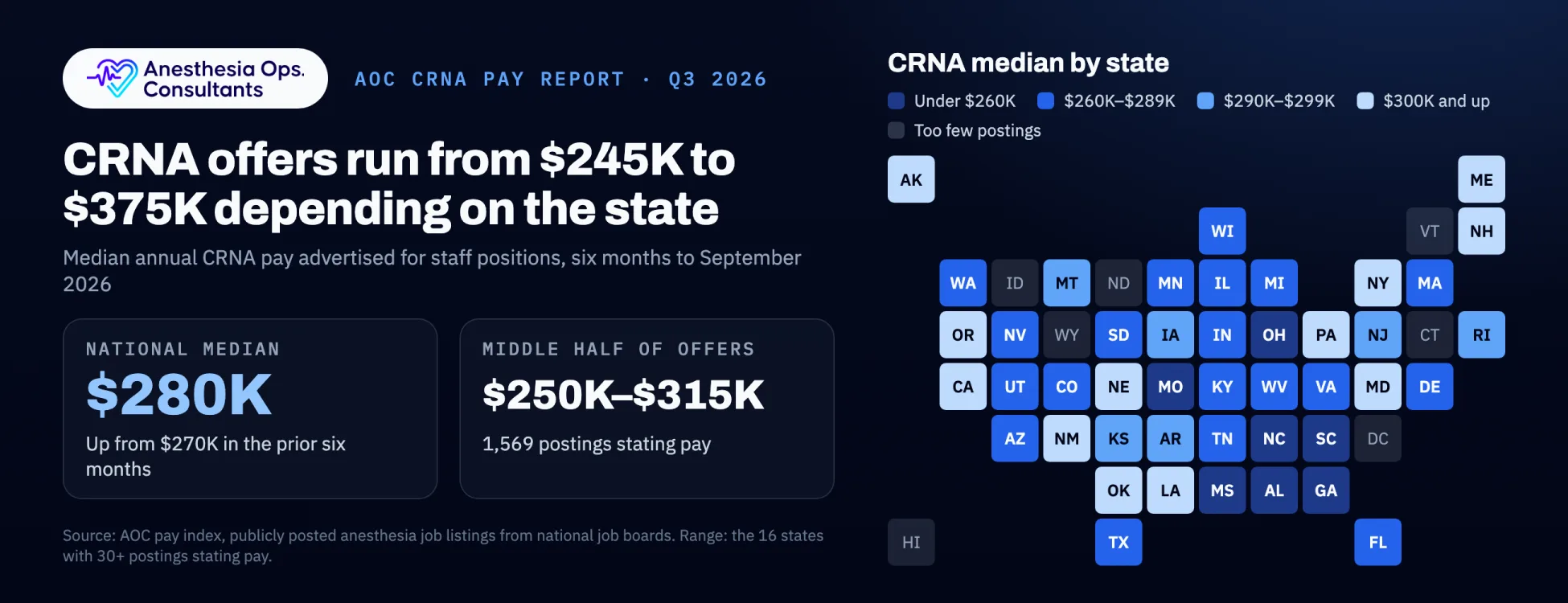
CRNA Pay Report, Q3 2026: What Job Postings Show
CRNA pay is still climbing; anesthesiologist pay has leveled off. Median posted CRNA pay for staff positions, six months to September 2026: $280,000, up about 4% on the prior six months. Pay by state and region, how hard it is to hire, and what it means for coverage costs.
Read Full Article